

How Did Colonization Play A Role In The Makeup Of The Texas Longhorn
:focal(1541x459:1542x460)/https://tf-cmsv2-smithsonianmag-media.s3.amazonaws.com/filer/96/4c/964c03cf-252b-4d33-bb62-2191596355d8/ih158432.jpg)
In his 1907 autobiography, cowboy Nat Love recounts stories from his life on the frontier and so cliché, they read like scenes from a John Wayne movie. He describes Contrivance Urban center, Kansas, a town smattered with the romanticized institutions of the frontier: "a great many saloons, dance halls, and gambling houses, and very picayune of anything else." He moved massive herds of cattle from one grazing area to another, drank with Billy the Kid and participated in shootouts with Native peoples defending their state on the trails. And when not, as he put it, "engaged in fighting Indians," he amused himself with activities like "dare-devil riding, shooting, roping and such sports."
Though Dearest'south tales from the frontier seem typical for a 19th-century cowboy, they come from a source rarely associated with the Wild Due west. Honey was African-American, born into slavery near Nashville, Tennessee.
Few images embody the spirit of the American W as well as the trailblazing, sharpshooting, horseback-riding cowboy of American lore. And though African-American cowboys don't play a function in the popular narrative, historians estimate that 1 in four cowboys were black.
The cowboy lifestyle came into its ain in Texas, which had been cattle country since it was colonized by Espana in the 1500s. But cattle farming did not go the bountiful economic and cultural phenomenon recognized today until the late 1800s, when millions of cattle grazed in Texas.
White Americans seeking cheap land—and sometimes evading debt in the United States—began moving to the Spanish (and, later, Mexican) territory of Texas during the showtime half of the 19th century. Though the Mexican regime opposed slavery, Americans brought slaves with them as they settled the borderland and established cotton farms and cattle ranches. By 1825, slaves accounted for nearly 25 percent of the Texas settler population. By 1860, 15 years after it became part of the Wedlock, that number had risen to over 30 per centum—that twelvemonth's demography reported 182,566 slaves living in Texas. Equally an increasingly significant new slave state, Texas joined the Confederacy in 1861. Though the Civil War hardly reached Texas soil, many white Texans took up arms to fight alongside their brethren in the East.
While Texas ranchers fought in the war, they depended on their slaves to maintain their land and cattle herds. In doing so, the slaves developed the skills of cattle tending (breaking horses, pulling calves out of mud and releasing longhorns defenseless in the brush, to proper name a few) that would render them invaluable to the Texas cattle industry in the post-state of war era.
Just with a combination of a lack of effective containment— barbed wire was not all the same invented—and besides few cowhands, the cattle population ran wild. Ranchers returning from the war discovered that their herds were lost or out of command. They tried to round upward the cattle and rebuild their herds with slave labor, only eventually the Emancipation Proclamation left them without the free workers on which they were so dependent. Drastic for assist rounding up bohemian cattle, ranchers were compelled to hire now-free, skilled African-Americans as paid cowhands.
/https://tf-cmsv2-smithsonianmag-media.s3.amazonaws.com/filer/e5/0a/e50ae602-469d-400c-a1fd-6a6f4c2199ab/natlove.jpg)
"Right afterward the Civil War, being a cowboy was i of the few jobs open to men of colour who wanted to not serve as elevator operators or delivery boys or other similar occupations," says William Loren Katz, a scholar of African-American history and the author of 40 books on the topic, including The Blackness West.
Freed blacks skilled in herding cattle plant themselves in even greater need when ranchers began selling their livestock in northern states, where beefiness was virtually 10 times more valuable than it was in cattle-inundated Texas. The lack of significant railroads in the land meant that enormous herds of cattle needed to be physically moved to shipping points in Kansas, Colorado and Missouri. Rounding up herds on horseback, cowboys traversed unforgiving trails fraught with harsh environmental conditions and attacks from Native Americans defending their lands.
African-American cowboys faced discrimination in the towns they passed through—they were barred from eating at certain restaurants or staying in certain hotels, for example—but within their crews, they found respect and a level of equality unknown to other African-Americans of the era.
Dear recalled the camaraderie of cowboys with adoration. "A braver, truer set up of men never lived than these wild sons of the plains whose home was in the saddle and their couch, mother earth, with the sky for a covering," he wrote. "They were e'er ready to share their blanket and their concluding ration with a less fortunate swain companion and always assisted each other in the many trying situations that were continually coming up in a cowboy'south life."
One of the few representations of black cowboys in mainstream entertainment is the fictional Josh Deets in Texas novelist Larry McMurtry's Lonesome Dove. A 1989 television miniseries based on the Pulitzer Prize-winning novel starred actor Danny Glover as Deets, an ex-slave turned cowboy who serves equally a lookout on a Texas-to-Montana cattle drive. Deets was inspired by real-life Bose Ikard, an African-American cowboy who worked on the Charles Goodnight and Oliver Loving cattle drive in the late-19th century.
"I roped, threw, tied, bridled, saddled and mounted my mustang in exactly nine minutes from the crack of the gun."
The real-life Goodnight's fondness for Ikard is clear in the epitaph he penned for the cowboy: "Served with me four years on the Goodnight-Loving Trail, never shirked a duty or disobeyed an order, rode with me in many stampedes, participated in iii engagements with Comanches. Splendid behavior."
"The West was a vast open up space and a dangerous place to be," says Katz. "Cowboys had to depend on one another. They couldn't finish in the heart of some crisis like a stampede or an attack past rustlers and sort out who's blackness and who's white. Black people operated "on a level of equality with the white cowboys," he says.
The cattle drives ended past the turn of the century. Railroads became a more than prominent mode of transportation in the Westward, barbed wire was invented, and Native Americans were relegated to reservations, all of which decreased the demand for cowboys on ranches. This left many cowboys, particularly African-Americans who could non hands buy state, in a time of rough transition.
Dear savage victim to the changing cattle industry and left his life on the wild borderland to become a Pullman porter for the Denver and Rio Grande railroad. "To us wild cowboys of the range, used to the wild and unrestricted life of the boundless plains, the new guild of things did non appeal," he recalled. "Many of us became disgusted and quit the wild life for the pursuits of our more civilized brother."
Though opportunities to become a working cowboy were on the decline, the public's fascination with the cowboy lifestyle prevailed, making style for the popularity of Wild West shows and rodeos.
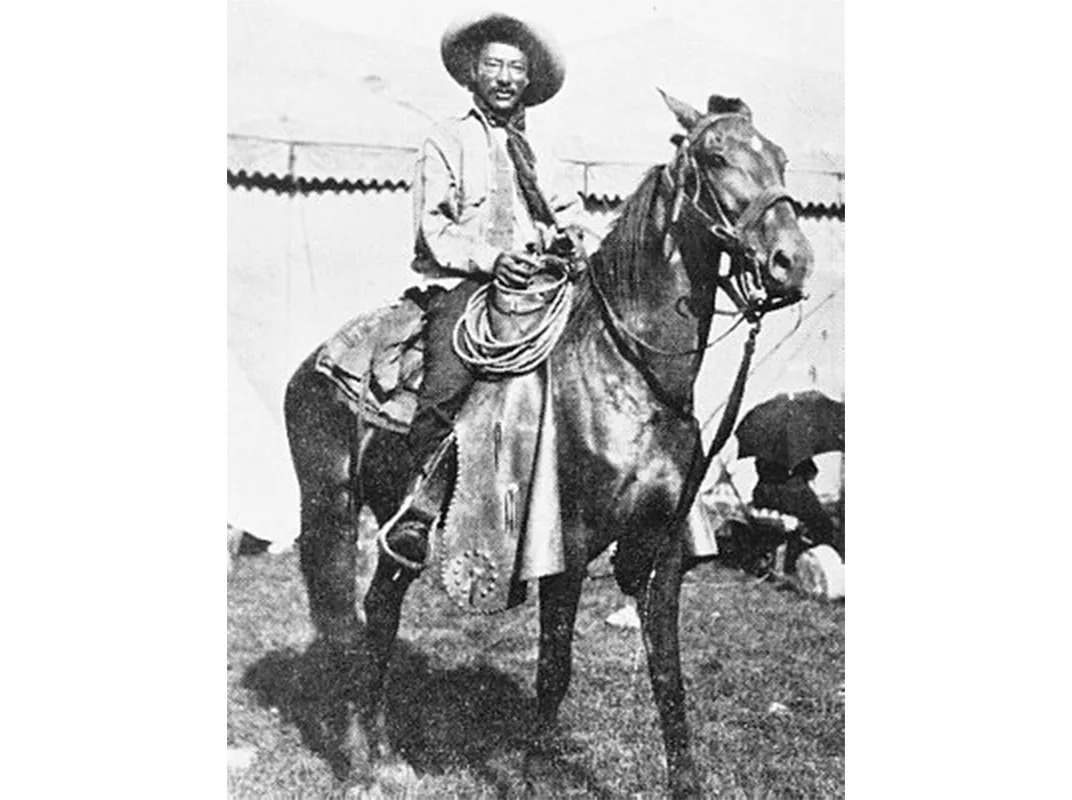
Nib Pickett, born in 1870 in Texas to sometime slaves, became one of the near famous early rodeo stars. He dropped out of school to become a ranch hand and gained an international reputation for his unique method of catching stray cows. Modeled subsequently his observations of how ranch dogs caught wandering cattle, Pickett controlled a steer by biting the moo-cow'due south lip, subduing him. He performed his pull a fast one on, called bulldogging or steer wrestling, for audiences effectually the earth with the Miller Brothers' 101 Wild Ranch Show.
"He drew adulation and admiration from young and old, cowboy to urban center slicker," remarks Katz.
In 1972, 40 years after his death, Pickett became the starting time black honoree in the National Rodeo Hall of fame, and rodeo athletes still compete in a version of his event today. And he was only the starting time of a long tradition of African-American rodeo cowboys.
Love, too, participated in early on rodeos. In 1876, he earned the nickname "Deadwood Dick" after entering a roping contest virtually Deadwood, Due south Dakota post-obit a cattle commitment. Six of the contestants, including Beloved, were "colored cowboys."
"I roped, threw, tied, bridled, saddled and mounted my mustang in exactly nine minutes from the cleft of the gun," he recalled. "My record has never been beaten." No equus caballus ever threw him as hard as that mustang, he wrote, "but I never stopped sticking my spurs in him and using my quirt on his flanks until I proved his master."
Seventy-six-year-erstwhile Cleo Hearn has been a professional cowboy since 1959. In 1970, he became the beginning African-American cowboy to win a calf-roping event at a major rodeo. He was also the first African-American to attend higher on a rodeo scholarship. He's played a cowboy in commercials for Ford, Pepsi-Cola and Levi's, and was the outset African-American to portray the iconic Marlboro Human. But being a black cowboy wasn't ever easy—he recalls existence barred from inbound a rodeo in his hometown of Seminole, Oklahoma, when he was sixteen years sometime considering of his race.
"They used to not let black cowboys rope in front of the crowd," says Roger Hardaway, a professor of history at Northwestern Oklahoma State University. "They had to rope afterwards everybody went home or the next morning."
But Hearn did non let the bigotry stop him from doing what he loved. Fifty-fifty when he was drafted into John F. Kennedy's Presidential Accolade Guard, he continued to rope and performed at a rodeo in New Jersey. After graduating with a caste in business from Langston University, Hearn was recruited to piece of work at the Ford Motor Company in Dallas, where he connected to compete in rodeos in his free time.
In 1971, Hearn began producing rodeos for African-American cowboys. Today, his Cowboys of Colour Rodeo recruits cowboys and cowgirls from diverse racial backgrounds. The touring rodeo features over 200 athletes who compete at several different rodeos throughout the twelvemonth, including the well-known Fort Worth Stock Show and Rodeo.
Although Hearn aims to train young cowboys and cowgirls to enter the professional rodeo industry, his rodeo's goals are two-fold. "The theme of Cowboys of Color is let usa brainwash you while nosotros entertain y'all," he explains. "Let us tell you the wonderful things blacks, Hispanics and Indians did for the settling of the West that history books have left out."
Though the forces of modernization somewhen pushed Love from the life he loved, he reflected on his time equally a cowboy with endearment. He wrote that he would "ever cherish a fond and loving feeling for the old days on the range its exciting adventures, good horses, skilful and bad men, long venturesome rides, Indian fights and last but foremost the friends I take made and friends I have gained. I gloried in the danger, and the wild and gratis life of the plains, the new country I was continually traversing, and the many new scenes and incidents continually arising in the life of a crude passenger."
African-American cowboys may withal be underrepresented in pop accounts of the West, merely the piece of work of scholars such as Katz and Hardaway and cowboys like Hearn go on the memories and undeniable contributions of the early African-American cowboys live.
Source: https://www.smithsonianmag.com/history/lesser-known-history-african-american-cowboys-180962144/
Posted by: jonesnuse1961.blogspot.com
0 Response to "How Did Colonization Play A Role In The Makeup Of The Texas Longhorn"
Post a Comment